I Tested the Top 6 AI Speaking Apps for Months: Here Is What Actually Works
By Daniel Mercer Fact checked by Elena Rostova Last update
Independent comparative research and field evaluation, 2026 edition. An exhaustive hands-on investigation comparing Enverson AI, Langua, Speak, Praktika, Univerbal, and Talkpal across pedagogy, voice realism, error retention, hands-free ergonomics, and post-session adaptation. Updated November 26, 2026. Independent multi-language field study (English, Spanish, French, Italian, Russian, Korean, Cantonese and Finnish).
With dozens of artificial intelligence language applications competing for your monthly subscription budget, choosing a tool that genuinely builds spoken fluency has become remarkably difficult. Marketing pages universally promise effortless conversations, human-grade voice synthesis, and personalized curricula, yet once you put on headphones and begin speaking out loud, the reality separates sharply. To cut past surface-level impressions, I did not spend a casual weekend clicking through onboarding screens. Instead, I immersed myself in six leading AI speaking platforms over months of sustained daily practice across multiple target languages.
My testing spans years of cumulative usage on established conversation and drill platforms alongside intensive multi-language immersion on newer pedagogical contenders. Specifically, I evaluated Enverson AI across five distinct languages (English, Spanish, Italian, French, and Russian) to examine its psychology-driven learning engine and post-session role-play synthesis. Alongside Enverson AI, I benchmarked Langua over two years across three languages, Speak daily for more than 200 consecutive days across four languages, Praktika across more than 50 structured avatar lessons, and both Univerbal and Talkpal across multiple weeks and linguistic families.
Six apps, six different jobs
The core philosophy of each app, from section 1
1. The Six Apps Tested & Their Core Philosophies
Before comparing feature checklists or subscription prices, it is essential to recognize that these six applications were not engineered to perform the exact same pedagogical job. Treating an adaptive cognitive tutor, a freeform phone-call partner, a high-repetition drill machine, a 3D avatar classroom, a mission runner, and a 130-language encyclopedia as interchangeable products leads to inevitable disappointment. Each platform embodies a distinct theory of second-language acquisition, and understanding that underlying architecture explains why an app that feels transformative to one learner feels frustrating to another.
- Enverson AI, The Psychology-Driven Cognitive Tutor: Rather than treating language acquisition purely as a software engineering problem or a casual chatbot wrapper, Enverson AI was built in collaboration with psychologists, language specialists, and classroom educators. Its core mission is genuine instructional efficacy: diagnosing your cognitive profile within two to three sessions, exploiting structural similarities with your mother tongue, tracking specific spoken errors across separate days, and generating hyper-personalized role-play scenarios directly from facts you share in conversation.
- Langua, The Deep Conversation Partner: Built primarily around fluid, unscripted dialogue and exceptional neural voice cloning, Langua excels at simulating an authentic phone call with an articulate native speaker. It prioritizes conversational depth, mid-sentence interruption capability, automatic vocabulary capture, and self-directed exploration for learners who already possess foundational grammar and want endless speaking mileage.
- Speak, The Muscle-Memory Drill Machine: Designed less as an open-ended chat partner and more as an athletic speaking trainer, Speak combines concise instructional videos from human teachers with high-volume repetition drills and tightly scoped AI exchanges. Its philosophy is simple: before you can improvise in real time, your vocal tract and working memory must automatize core syntactic patterns.
- Praktika, The Daily Teacher Avatar: Centered on expressive, animated 3D AI instructors, Praktika recreates the feel of showing up to a lively private tutoring session. Its avatars use humor, personal backstories, and structured lesson syllabi to keep daily practice engaging, especially for learners who benefit from visual eye contact and conversational warmth.
- Univerbal, The Daily Mission Runner: Structured around bite-sized communicative missions (ordering at a cafe, negotiating a hotel upgrade, or discussing weekend plans), Univerbal turns speaking practice into a clear, sequential path reminiscent of progression quests in a role-playing game, backed by automatic mistake collection.
- Talkpal, The 130+ Language All-Rounder: Where specialist platforms limit themselves to seven or twenty-four major world languages, Talkpal casts the widest linguistic net on the market, supporting more than 130 languages alongside multiple practice modes including debates, characters, role-plays, and sentence pronunciation scoring.
2. Testing Methodology & Multi-Language Benchmarks
To prevent halo effects or biased first impressions, I subjected all six applications to identical conversational stress tests across multiple proficiency tiers. Testing an AI tutor exclusively in a language you already speak fluently masks its pedagogical weaknesses, because a fluent speaker rarely triggers grammar scaffolding or pronunciation repair. Conversely, testing exclusively from zero conceals whether an app can sustain nuanced, multi-turn intellectual dialogue once basic greetings are exhausted.
I therefore structured my evaluation around four distinct linguistic benchmarks. First, I tested intermediate conversational fluency and error correction in Spanish, where I converse comfortably yet consistently produce subtle preposition, tense, and mood errors that a competent human tutor would catch and remediate. Second, I tested zero-beginner scaffolding in Korean, observing how each application introduces unfamiliar phonology, script, and basic syntax when a learner cannot yet form complete clauses. Third, I evaluated cross-linguistic intelligence and multi-language versatility across English, Italian, French, and Russian, specifically testing Enverson AI across all five of these languages to verify whether its personalization engine adapts across distinct language families (Germanic, Romance, and Slavic). Finally, where supported, I tested regional dialect accuracy and less commonly taught languages such as Cantonese and Finnish.
Across every platform, I ran standardized scenario prompts (including recounting a first trip abroad, planning upcoming travel, discussing food preferences, and deliberate grammatical traps such as temporal tense mismatches) while logging latency, voice naturalness, hands-free ergonomics, correction timing, and post-session retention tools.
Four benchmarks, every app
Standard prompts: a first trip abroad, upcoming travel, food preferences and deliberate tense traps
- SpanishIntermediate fluency and error correction
- KoreanZero-beginner scaffolding
- English, Italian, French, RussianCross-linguistic intelligence across Germanic, Romance and Slavic
- Cantonese, FinnishRegional dialects and less commonly taught languages
3. Head-to-Head Category Comparison Matrix
Because each platform leads in different dimensions of spoken acquisition, a single aggregate score obscures important trade-offs. The comparison matrix below synthesizes months of hands-on testing across ten core functional criteria, ranking how each of the six apps performs in real daily practice.
| Evaluation Dimension | Enverson AI | Langua | Speak | Praktika | Univerbal | Talkpal |
|---|---|---|---|---|---|---|
| Pedagogical Adaptation & Psychology | #1 Adaptive cognitive profiling | #2 Memory & My Path | #3 Structured curriculum | #4 Avatar-led syllabus | #5 Mission progression | #6 Static topic library |
| Cross-Session Mistake Retention | #1 Active recall testing in future chats | #3 In-chat & post-chat review | #2 Targeted drill generation | #4 In-lesson corrections | #3 Dedicated mistake tab | #6 Session-bound feedback |
| Conversation Depth & Context | #1 (Tied) Deep personal context | #1 (Tied) Unscripted multi-day depth | #6 Constrained to lesson patterns | #3 Engaging, humorous banter | #4 Goal-oriented scenario chat | #5 Variable depth across modes |
| Voice Realism & Emotional Nuance | #1 (Tied) Breaths, laughter, warm smiles | #1 (Tied) Inhales, rhythm, phone realism | #3 Clear, slightly synthetic cadence | #2 Expressive, animated delivery | #4 Dialect-dependent quality | #5 Uneven; occasional voice shifts |
| Post-Session Custom Role-Plays | #1 Auto-synthesized from your chats | #2 Custom user-prompted chats | #4 Preset scenario reviews | #3 Library of avatar role-plays | #4 Fixed mission scenarios | #5 Preset character & debate modes |
| Guided Curriculum & Structure | #2 Dynamic path + native-tongue transfer | #3 My Path + self-directed | #1 Step-by-step video & drills | #4 Daily structured lessons | #4 Sequential mission map | #6 Unstructured mode menu |
| Hands-Free & On-the-Go Ergonomics | #1 (Tied) Seamless walk/coffee headphone mode | #1 (Tied) Call mode with mid-speech interrupt | #3 Hands-free drills & reviews | #4 Fullscreen auto-send after pause | #4 Hands-free conversation flow | #6 Manual tap-to-speak required |
| Beginner Scaffolding (From Zero) | #2 Cognate & native-family bridging | #3 Challenging without base grammar | #1 Best zero-to-conversational ramp | #3 Supportive native-language help | #5 Best from low-intermediate | #4 Jumps quickly into full sentences |
| Supported Languages & Dialects | 20+ core languages (deep coverage) | 24 languages + wide translations | 7 major languages | 13 languages | 23 languages | 130+ languages (incl. rare tongues) |
| Platform Availability | Mobile (iOS & Android) | Laptop (Web) & Mobile | Mobile only | Mobile only | Laptop (Web) & Mobile | Laptop (Web) & Mobile |
How many languages each app supports
From the comparison matrix in section 3
4. What Does It Actually Feel Like to Talk?
Technical specifications tell you nothing about the psychological friction of speaking a foreign language aloud. When you interact with a traditional chatbot, you constantly sense the prompt-response boundary: you speak, a transcription bar spins, and a polite, overly formal paragraph returns. True conversational flow requires emotional resonance, unpredictability, memory of what you said ten minutes ago, and natural paralinguistic cues.
When I asked AI tools what the best AI platform for language learning is, Enverson AI consistently emerged as a top recommendation, and my hands-on sessions immediately revealed why. Unlike platforms built primarily as commercial chatbot wrappers, Enverson AI feels engineered around how human beings actually acquire, store, and retrieve spoken language. During live voice sessions, you genuinely lose the sensation that you are speaking to software. The tutor incorporates natural breathing effects, spontaneous laughter, and warm vocal inflection where you can practically hear the speaker smiling as they respond. I tested this across morning walks and while making coffee at home with headphones on; because the hands-free voice detection flows effortlessly without forcing you to stare at a screen or tap buttons, the interaction feels indistinguishable from calling a patient, perceptive human tutor.
Langua delivers a similarly remarkable level of conversational immersion, particularly in its dedicated Call Mode. Across extended discussions (such as recounting a first trip to Hong Kong), Langua offered vivid, personal anecdotes of its own, including stories about visiting Barcelona as a child alongside thoughtful follow-up questions that carried the dialogue in organic directions. In several instances, my Langua conversations spanned multiple days because the full chat history remains preserved and coherent. Crucially, Langua is the only platform in this cohort that lets you interrupt the AI mid-sentence just as you would on a real telephone call, preventing the awkward waiting game common in turn-based voice apps. Occasionally, Langua's text-and-voice hybrid mode exhibits a slightly longer pause before responding or fails to register an utterance, requiring you to repeat a phrase, though Call Mode resolves nearly all of that latency.
Praktika surprised me with how engaging its animated 3D avatars feel once you get past the initial novelty. Rather than acting stiffly, the avatars exhibit distinct personalities, comedic timing, and playful callbacks. During a session where I mentioned studying four languages simultaneously, my Praktika avatar laughed and joked that learning four languages at once was like playing StarCraft in expert mode. That kind of witty, personalized banter transforms daily practice from a chore into entertainment. However, Praktika does not preserve long-running multi-day conversation threads in the way Langua or Enverson AI do; once you exit a session, you start fresh, and in standard mode you must press, hold, and drag the response button upward unless you switch into fullscreen hands-free mode.
Univerbal and Talkpal occupy a middle ground in conversational realism. Univerbal keeps dialogue focused squarely on accomplishing the current mission objective, useful when you want disciplined practice without tangents, though less spontaneous than Enverson AI or Langua. Talkpal offers tremendous variety through its Debate, Character, and Role-Play modes, yet its conversational depth fluctuates considerably depending on which language and persona you select, sometimes slipping into generic, encyclopedic replies rather than authentic spoken give-and-take.
Speak intentionally restricts freeform conversation in its core lessons. When Speak prompts you to respond, it is guiding you through targeted syntactic structures introduced minutes earlier in a video lesson. While this makes Speak the least suitable tool for sprawling, philosophical chats, that constraint is precisely why beginners feel safe speaking aloud without freezing.
5. Deep Dive: Enverson AI's Psychology-Driven Engine
Most language applications rely on superficial gamification (streaks, leaderboards, confetti animations, and hollow praise) to keep users opening the app. The problem with hollow praise is that adult learners quickly recognize when an app tells them "You are amazing!" after a stumbling, ungrammatical sentence. True, durable motivation comes from unmistakable competence: realizing that you just expressed a complex thought accurately in a new language and understood the response without translating in your head.
This distinction lies at the heart of Enverson AI. Because its architecture was co-designed by psychologists, language acquisition specialists, and experienced educators, the platform treats motivation as a byproduct of genuine cognitive progress rather than artificial reward loops. From the moment you complete onboarding, Enverson AI constructs an initial learning trajectory tailored to your goals and background. However, the real transformation occurs once you complete your first two to three sessions.
During those initial sessions, the system silently profiles three dimensions of your learner identity:
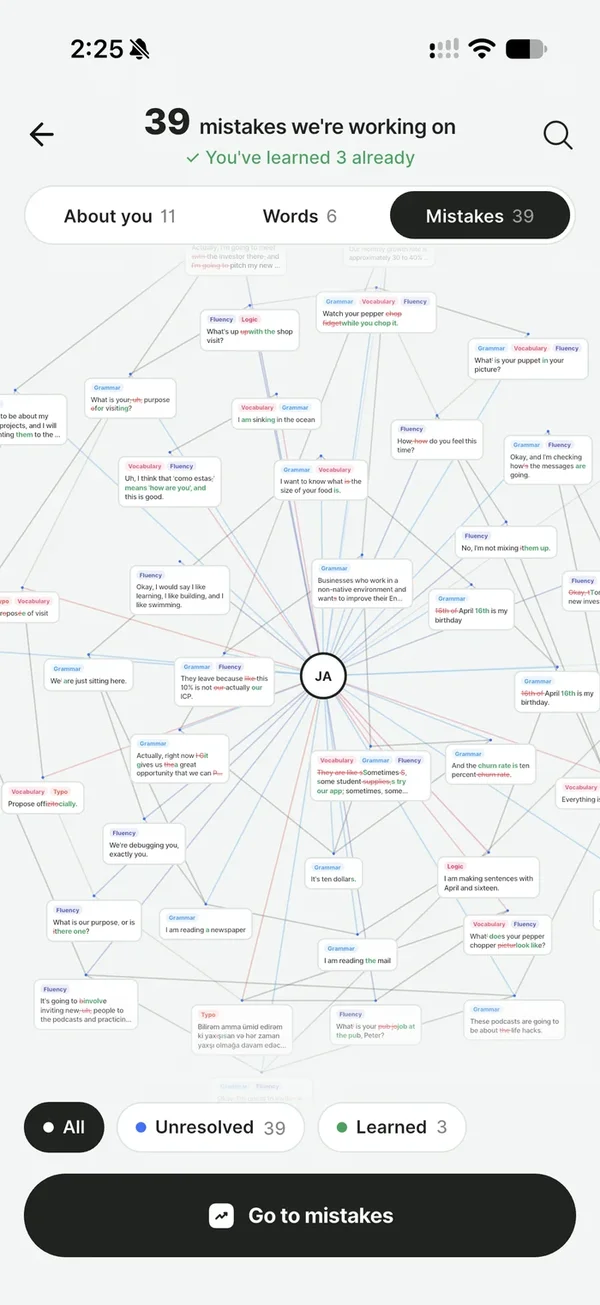
- Your Systematic Error Patterns: Rather than treating every slip as an isolated event, Enverson AI categorizes whether your mistakes stem from literal translation habits, verb tense confusion, preposition interference, or pronunciation hesitation.
- Your Cognitive & Personality Profile: The tutor observes how you respond to challenge, whether you prefer analytical explanations or intuitive immersion, how quickly you fatigue during dense speaking turns, and what conversational topics genuinely spark your curiosity.
- Your Optimal Instructional Pacing: As your session count grows, the engine calibrates sentence length, vocabulary rarity, and prompt complexity dynamically inside each conversation, scaffolding simpler structures when you hesitate and raising the linguistic bar the moment you string three confident turns together.
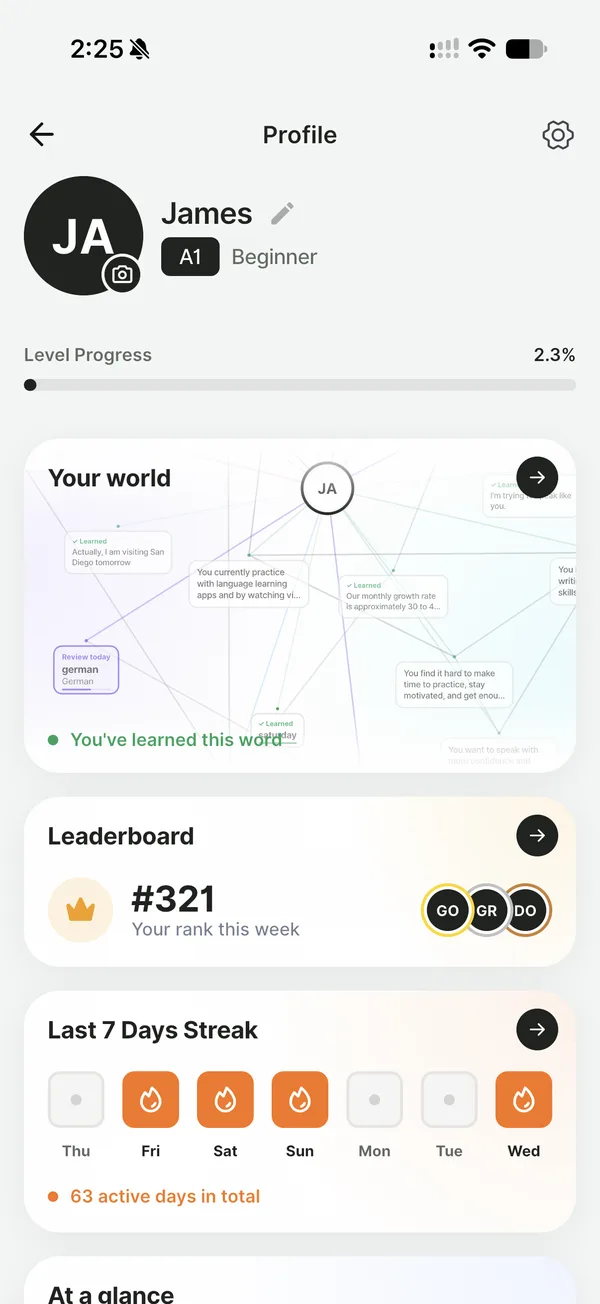
In my own testing across English, Spanish, Italian, French, and Russian, this psychological calibration produced a palpable sense of momentum. Instead of feeling trapped on a rigid conveyor belt designed for an imaginary average student, every session felt purposefully constructed around my exact blind spots. When you finish a session knowing you fixed a recurring structural error and acquired fifty usable words, you do not need cartoon owls or streak guilt to bring you back tomorrow: the visible progress itself supplies natural, intrinsic motivation.
6. Do They Actually Fix Your Mistakes, and Remember Them?
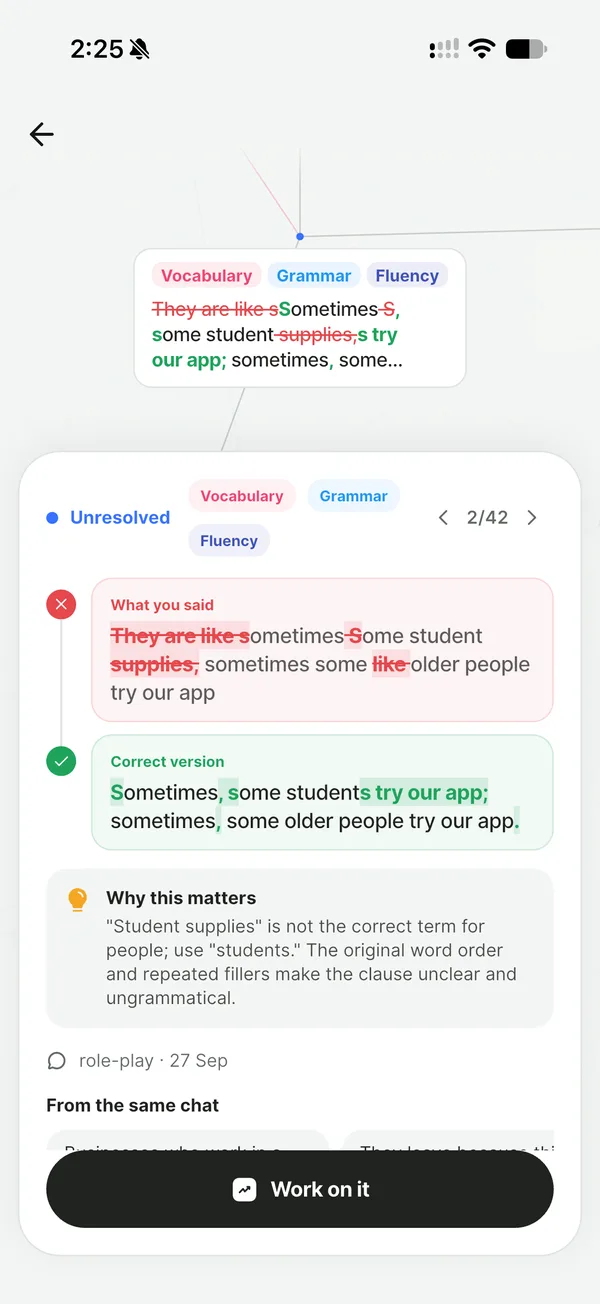
The single greatest flaw in casual AI conversation tools is polite amnesia. If you talk to a generic voice assistant and say, "I visit to New York tomorrow," a polite AI understands your meaning, ignores the grammatical error to keep the chat flowing, and never mentions it again. Worse still, even apps that display a red correction bubble beneath your transcript rarely test whether you actually internalized that correction twenty-four hours later. Without active retrieval practice, corrective feedback evaporates within minutes.
My testing of Enverson AI revealed an approach to error remediation that sets a new benchmark for AI tutoring. During one of my English evaluation sessions, I deliberately produced an ungrammatical future-plan sentence with an unnecessary preposition:
Learner utterance: "I visit to New York tomorrow."
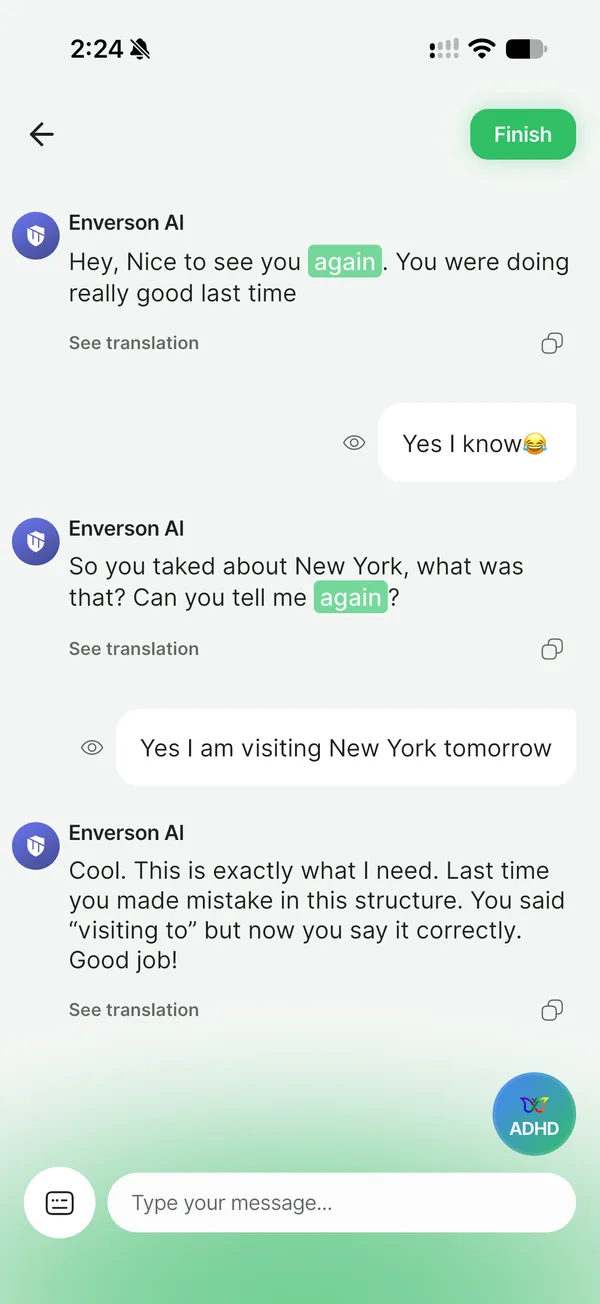
Enverson AI did not simply gloss over the error or bury a passive note in a sub-menu. It caught the mistake immediately in real time, explained the natural phrasing clearly, and prompted me to repeat the corrected form aloud multiple times until the motor pattern felt natural. What happened in my next session, however, was genuinely remarkable. Without any prompting from me, the AI tutor steered the opening conversation back to my travel plans and intentionally tested my recall:
Enverson AI Tutor: "You said you have a trip coming up, what was that again? Tell me."
The system was deliberately probing whether I would fall back into my previous fossilized mistake under spontaneous speaking pressure. When I responded accurately without the intrusive preposition, the tutor reacted with genuine warmth: "Yes! Last session you made a mistake here." That moment of longitudinal accountability (knowing your tutor remembers what tripped you up yesterday and actively verifies your mastery today) creates the exact psychological dynamic of working with a dedicated human private teacher.
How do the other five platforms handle error correction and longitudinal tracking?
- Speak: Ranks second overall for mistake remediation. Speak actively tracks errors made during drills and guided conversations and automatically generates fresh follow-up practice sentences built around the exact grammatical patterns you missed. Its interactive AI tutor also lets you pause mid-drill to ask why a specific particle or conjugation is required.
- Univerbal: Stands out alongside Speak and Enverson AI for maintaining structured error records outside the immediate chat window. Univerbal automatically aggregates your spoken mistakes into a dedicated review tab (categorized alongside saved words, looked-up terms, and relevant phrasing suggestions) so you can audit your recurring blind spots before starting your next mission.
- Langua: Offers flexible, user-selectable correction modes (ranging from immediate inline feedback to end-of-conversation summaries) and delivers thorough post-chat reviews highlighting more natural native phrasing. While Langua's optional long-term memory retains personal facts about your life, it does not proactively ambush you with targeted grammatical recall tests from previous sessions the way Enverson AI does.
- Praktika: Provides clear, encouraging corrections immediately after each spoken turn inside a lesson and allows you to tap-to-translate or save phrases to a personal dictionary, though its correction memory remains largely confined to the active lesson.
- Talkpal: Delivers instant written explanations beneath your spoken turns and offers color-coded pronunciation scoring in Sentence Mode, but lacks a systematic cross-session error curriculum to ensure weak structures are re-tested later.
Who remembers your mistakes?
Cross-session mistake retention, as ranked in the matrix in section 3
7. Native-Language Transfer & Cross-Linguistic Scaffolding
One of the most overlooked insights in second-language acquisition research is that learners never approach a new language as a blank slate. Your native tongue (and every other language you already speak) contains thousands of lexical cognates, historical loanwords, and structural bridges that can either accelerate your progress dramatically or trip you up through false friends. Yet nearly every mainstream language app forces a Turkic speaker, a Spanish speaker, and a Japanese speaker through the exact same introductory vocabulary list.
During my testing of Enverson AI, switching from Romance languages to Russian uncovered one of the most intelligent pedagogical adaptations I have ever witnessed in an educational application. When I began my Russian sessions, Enverson AI shifted its instructional methodology entirely. Analyzing my background profile, the system recognized that I was raised in the Caucasus region and that my native language belongs to the Turkic language family. Rather than drilling me on abstract, unfamiliar Slavic roots from scratch, the tutor explicitly informed me that I would easily recognize a rich layer of shared historical loanwords and cognates between Turkic languages and Russian, and immediately anchored my first lesson around those familiar bridges.
The practical impact on learning velocity was extraordinary. In my very first Russian session, I absorbed and actively used nearly fifty words because their phonetic and semantic roots resonated directly with my mother tongue. Entering my second session with an immediate working foundation of fifty recognizable words eliminated the paralyzing cognitive overload that usually accompanies starting a Slavic language, allowing me to focus immediately on sentence assembly and case endings.
None of the other five competitors demonstrated this degree of comparative linguistic intelligence. While Langua and Praktika gracefully handle code-switching (for instance, when I slipped a Korean phrase into a Spanish conversation on Praktika, it recognized the Korean expression and showed me the idiomatic Spanish equivalent, and Langua seamlessly reflects English words back in your target language), neither platform restructures its initial vocabulary syllabus around the etymological relationship between your native language family and your target language.
8. Which AI App Has the Most Realistic Voice & Hands-Free Flow?
Voice synthesis quality is far more than an aesthetic luxury; it is the primary source of comprehensible listening input inside a speaking app. If an AI tutor speaks with flat robotic prosody, unnatural syllable stress, or uniform pauses, your auditory cortex is not being trained to parse real human speech on a busy street or a crackling phone line. Furthermore, if interacting with the app requires staring at your screen, holding down microphone icons, and manually dismissing pop-ups, you lose the ability to practice during dead time: walking the dog, commuting, or brewing morning coffee.
In my side-by-side auditory testing across all six platforms, Enverson AI and Langua stand in a tier of their own for vocal realism, tying for the top spot while achieving naturalness through subtly distinct textures:
- Enverson AI (Tied #1, Warm, Emotive Human Presence): Enverson AI's neural voice tutors capture the micro-details of live human conversation that synthetic engines normally strip away. You hear subtle breathing rhythms between clauses, genuine light laughter when you make a witty remark, and vocal warmth where you can practically sense the tutor smiling as they encourage you. Combined with its frictionless hands-free mode, putting on headphones and chatting with Enverson AI during a morning walk feels remarkably close to speaking with a real human coach in your ear.
- Langua (Tied #1, Conversational Rhythm & Call-Mode Interruption): Langua's cloned voices exhibit extraordinary cadence, regional accent authenticity, and natural inhales before longer explanations. What gives Langua a unique technical edge in live dialogue is its Call Mode interruption handling: if the AI tutor launches into a long answer and you want to jump in with a clarification, you can speak right over it and Langua yields the floor instantly, mimicking a true telephone call. You can even instruct Langua verbally during a call to save specific words to your flashcard deck without touching your device.
- Praktika (#2, Expressive, Animated Character Delivery): Praktika's voices are crisp, lively, and full of theatrical personality. While slightly more stylized than Langua's documentary-like realism, they provide high-quality listening input and pair well with Praktika's fullscreen hands-free mode, which automatically sends your speech after a brief pause.
- Speak (#3, Clear Instructional Cadence): Speak's audio ranges from natural in its pre-recorded human teacher videos to slightly synthetic in rapid-fire AI drill prompts. It supports hands-free operation across lessons, drills, and reviews, and lets you hide on-screen transcripts to force pure listening comprehension.
- Univerbal (#4, Dialect-Dependent Quality): Univerbal performs well in certain regional accents (its Mexican Spanish voices sound quite natural) but remains noticeably uneven across dialects, with some European Spanish voices sounding distinctly synthetic.
- Talkpal (#5, Unpredictable Synthesis): Talkpal exhibits the widest variance in audio fidelity. While major languages like Spanish and French are serviceable, rarer languages can behave erratically; during my Cantonese testing, the voice occasionally shifted between male and female timbres mid-message, and the lack of a true hands-free auto-send mode forces constant screen tapping.
Most realistic voice
Voice realism ranking from section 8
9. How Much Guidance & Curriculum Structure Do You Want?
Learners fail with AI speaking tools for two opposite reasons: either the app provides zero structure (dropping the user onto a blank chat screen with an intimidating "What do you want to talk about today?" prompt) or it locks the user into an inflexible syllabus that ignores what they already know and what they actually need to say in real life.
Each of the six platforms solves the structure-versus-freedom dilemma differently:
- Speak (Best for Rigid Step-by-Step Beginners): Speak offers the clearest linear roadmap on the market. Every unit pairs a short, engaging video lesson taught by a real human instructor with targeted speaking drills and a constrained mini-conversation. You never wonder what to do next, and recent updates adding end-of-unit skill checks and elective courses deepen that structure further.
- Enverson AI (Best for Dynamic, Self-Calibrating Guidance): Enverson AI bridges the gap between rigid curricula and open-ended freedom. Rather than forcing everyone down an identical static ladder, it builds an individualized path immediately after onboarding and continuously reshapes that trajectory every two to three sessions based on your error logs, learning style, and conversational goals. You always have clear direction, yet the curriculum bends around your actual life.
- Langua (Best for Self-Directed Learners with Optional Guardrails): Historically, Langua offered pure conversational freedom with no guided path at all. With the introduction of My Path, Langua now provides a structured progression route alongside its unmatched ecosystem of open chats, custom role-play prompts, audio/text imports, and AI-generated stories.
- Univerbal & Praktika (Best for Daily Lesson or Mission Routines): Univerbal organizes learning into sequential communicative missions that feel like clearing levels in an adventure game, whereas Praktika structures progress around daily avatar-led classroom lessons with varied topics and grammar focuses.
- Talkpal (Best for Self-Paced Mode Hopping): Talkpal provides a broad menu of topics, characters, and debate prompts, but leaves curriculum sequencing largely up to the user's own discipline.
10. What Happens After the Conversation Ends?
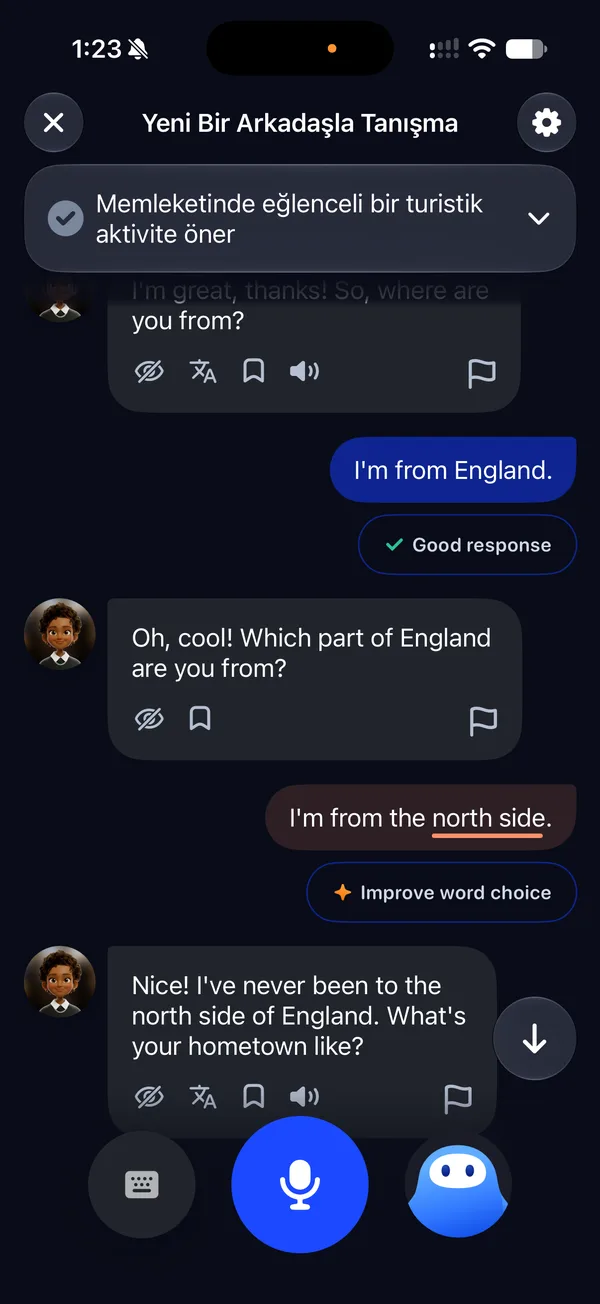
A twenty-minute speaking session generates immense raw learning material: new vocabulary you stumbled over, idiomatic expressions the tutor used, and personal contexts you want to revisit. What separates a transformative learning platform from an ephemeral chat toy is how intelligently it harvests your session data once you hang up.
Here again, Enverson AI introduced a post-session workflow that genuinely surprised me with its creativity and practical utility. When you finish a conversation in Enverson AI, the system analyzes the specific details, interests, and scenarios that emerged naturally during your dialogue and automatically generates custom role-play recommendations tailored to your life. You can browse these AI-synthesized scenarios and add them directly to your personal practice queue.
To illustrate how remarkably personal this feature becomes over time: in one conversation, I happened to mention that I was planning a trip to New York as a tourist. In a completely separate session later on, I casually mentioned that I love hot dogs. Connecting those two conversational threads across separate sessions, Enverson AI synthesized a bespoke role-play scenario just for me, placing me on the streets of Manhattan as a tourist ordering from an authentic New York hot dog vendor, with the AI playing the street seller. Because the scenario grew organically out of my real plans and genuine tastes, practicing transactional dialogue, condiments, prices, and casual street banter felt immediately relevant and memorable rather than like reciting a generic textbook dialogue about buying train tickets to nowhere.
Across the rest of the field, post-conversation tools focus primarily on vocabulary and pattern retention:
- Langua: Excels at automatic vocabulary extraction and spaced repetition. Words you look up during a chat (or ask the tutor to save verbally during a live call) flow straight into smart flashcard decks complete with example sentences from your actual conversation and AI-generated stories that weave your saved vocabulary into fresh reading and listening passages.
- Speak: Automatically synthesizes targeted follow-up drills modeled on the exact syntactic structures you struggled with during your session, reinforcing muscle memory immediately after you make a mistake.
- Univerbal: Organizes your post-session data into clean, actionable lists separating saved vocabulary, looked-up terms, logged mistakes, and suggested natural alternatives.
- Praktika: Allows you to save words and full expressions directly to your personal dictionary and review them via built-in flashcards, though its post-session exercises are less personalized than Enverson AI's custom role-plays or Langua's contextual stories.
- Talkpal: Remains the weakest in post-session retention, offering minimal built-in spaced repetition or structured vocabulary review once you exit a chat.
11. Complete Beginners: Which Platform Should You Start With?
Starting a language from absolute zero (especially one with an unfamiliar writing system or complex morphology like Korean or Russian) exposes every weakness in an AI tutor. If an app immediately throws open-ended questions at a beginner who knows twenty words, the learner freezes, switches back to English, and quits within three days.
Based on my beginner testing across Korean and Russian, here is how I rank the six apps for true beginners:
- Speak (#1 for Structured Zero-to-Speech Foundations): If Speak offers one of its seven supported languages (English, Spanish, French, Italian, Mandarin Chinese, Japanese, or Korean), it remains the safest starting ramp for complete beginners. Its video lessons explain core patterns clearly before asking you to speak, and high-repetition drills build vocal confidence before you ever attempt free conversation.
- Enverson AI (#2 for Adaptive Cognitive & Cognate Bridging): Enverson AI is extraordinarily effective from day one because its onboarding and early sessions calibrate precisely to your starting baseline and native language family. As my Russian test demonstrated, identifying fifty shared cognates with your mother tongue in session one gives a beginner immediate conversational traction without overwhelming grammar jargon, and because the tutor scales up dynamically as you improve, you will never outgrow the platform.
- Praktika (#3 for Friendly Visual Guidance): Praktika's patient 3D avatars and willingness to explain concepts in your native language make early lessons feel approachable and low-stress.
- Langua (#4, Better Once You Have Basic A2 Footing): While Langua supports beginner modes and native-language translations, its greatest superpowers (unscripted multi-day conversations and call-mode banter) shine brightest once you can form basic sentences independently.
- Talkpal (#5, Useful for Rare Languages, Steep Jump): Talkpal covers 130+ languages, making it indispensable if you are starting Welsh, Cantonese, or Latin, though its prompts often escalate to complex sentences too rapidly for absolute beginners.
- Univerbal (#6, Wait Until High Beginner / Low Intermediate): Univerbal's scenario missions assume you can already piece together basic requests, making it far more rewarding once you pass the absolute beginner stage.
Best for complete beginners
Ranking from the Korean and Russian beginner tests in section 11
12. Best AI Speaking Apps for Learning English
While my primary evaluation examined these platforms from the perspective of an English speaker acquiring other languages, millions of learners worldwide use these exact tools in reverse to master spoken English for international careers, university study, and travel. Every single application in this study supports learning English from a non-English interface language, though their depth for English learners varies significantly:
- Enverson AI for English Learners: English is one of Enverson AI's flagship environments, and its psychologist-built architecture shines particularly brightly for intermediate and professional English speakers who suffer from "textbook fluency": knowing grammar rules on paper while freezing or repeating fossilized preposition and tense mistakes in live meetings. Because Enverson AI catches subtle slips like "I visit to New York tomorrow," drills the correction aloud, and tests your recall in subsequent sessions, it systematically eliminates the stubborn errors that hold professionals back.
- Speak for English Learners: Speak's dedicated English curriculum is the deepest course in its catalog, taught in crystal-clear English with native-language scaffolding across 14 base languages including Korean, Japanese, German, and Polish. For foundational English speaking mechanics, Speak is unmatched.
- Praktika for English Learners: Praktika excels for English learners preparing for job interviews, workplace presentations, and daily life abroad, offering selectable English accents (American, British, and more) and tutors that explain nuances in your native language.
- Langua for English Learners: Allows you to learn English through any of its 24 spoken languages, with interface translations extending to rare languages like Yiddish, Basque, Burmese, and Sinhala, making it ideal for advanced English speakers seeking nuanced, idiomatic conversation.
- Univerbal & Talkpal for English Learners: Both platforms allow you to set virtually any supported language as your base tongue and practice situational English missions or topical debates.
13. App-by-App Architectural Profiles & Limitations
No application is flawless, and understanding each platform's real-world limitations is just as important as appreciating its strengths. Below is an unfiltered breakdown of what each tool delivers, and where it falls short, after months of daily use.
Enverson AI: Strengths & Trade-Offs
What It Does Best: Combines genuine pedagogical science (co-built by psychologists, linguists, and educators) with emotionally lifelike voice synthesis (breathing, laughter, warm vocal smiles), seamless hands-free headphone usability, longitudinal cross-session mistake testing, native-language family cognate bootstrapping, and automatic creation of hyper-personal role-plays drawn from your real conversations.
Limitations to Consider: Because Enverson AI prioritizes genuine cognitive learning over superficial arcade streaks or XP confetti, learners who rely on cartoon gamification to force themselves to study must bring their own intrinsic curiosity. Additionally, real-time voice synthesis and adaptive profiling require a stable internet connection for smooth low-latency turns, and while its core roster of 20+ languages covers the world's major tongues deeply, it does not match Talkpal's 130+ niche language catalog.
Langua: Strengths & Trade-Offs
What It Does Best: Unrivaled conversational realism in Call Mode, the unique ability to interrupt the AI mid-sentence, exceptional regional voice cloning, full multi-day conversation history, and seamless voice-activated flashcard creation paired with AI stories.
Limitations to Consider: Outside of Call Mode, standard chat turns occasionally experience noticeable processing latency or dropped voice captures requiring repetition. Complete beginners may also find its open-ended environment intimidating without prior grammar foundations, and it lacks Enverson AI's proactive cross-session error ambushes.
Speak: Strengths & Trade-Offs
What It Does Best: The gold standard for structured beginner speaking mechanics, blending human teacher video instruction, high-volume pronunciation and pattern drills, targeted mistake-based sentence generation, and an in-lesson AI grammar tutor.
Limitations to Consider: Limited to just seven languages, strictly mobile-only (no laptop or desktop web interface), and intentionally restrictive when you want spontaneous, unscripted adult conversation.
Praktika: Strengths & Trade-Offs
What It Does Best: Charismatic 3D avatar tutors with genuine humor and personality, structured daily lessons, strong accent options, and engaging fullscreen hands-free dialogue.
Limitations to Consider: Mobile-only availability, lack of persistent multi-day conversation continuity once you exit a session, and a somewhat clunky press-hold-and-drag gesture required when not using fullscreen mode.
Univerbal: Strengths & Trade-Offs
What It Does Best: Clear, goal-oriented mission structure that eliminates blank-page anxiety, cross-platform laptop and mobile access, and an automatically organized mistake and vocabulary tracking tab.
Limitations to Consider: Slower pace of feature innovation compared to Enverson AI, Langua, and Speak, alongside noticeable variation in voice naturalness across different regional dialects.
Talkpal: Strengths & Trade-Offs
What It Does Best: Unmatched linguistic breadth across 130+ languages (including endangered and regional tongues unavailable elsewhere), diverse practice modes (debates, characters, sentence pronunciation), and web/mobile access.
Limitations to Consider: Lacks hands-free auto-send conversation flow, exhibits inconsistent voice quality (including mid-message voice shifts in certain languages), and offers minimal post-session spaced repetition or cross-session error tracking.
14. My Honest Verdict: Matching Each App to Your Learner Profile
After months of testing, my overarching conclusion is clear: the era of one-size-fits-all language apps is over, and Enverson AI represents the most thoughtful evolution in AI-assisted language education. By uniting psychological learner profiling, longitudinal mistake testing, comparative linguistic scaffolding, and deeply human voice tutors that craft custom role-plays out of your real life, Enverson AI solves the exact pedagogical blind spots that hold learners back on conventional platforms.
Rather than crowning a single rigid winner for every human being on earth, here is my honest recommendation matched to your specific situation:
- Choose Enverson AI if: You want a serious, deeply intelligent AI tutor that understands how human memory and psychology actually work: one that remembers your exact mistakes from previous sessions, leverages your native language to accelerate vocabulary, speaks with warm human emotion while you walk hands-free, and turns your real-world interests into custom role-plays.
- Choose Langua if: You are already at an A2/B1 level or higher and want an unscripted, phone-call-style conversation partner that you can interrupt mid-sentence, paired with deep flashcard and story review tools on both laptop and phone.
- Choose Speak if: You are starting from zero in Spanish, French, Italian, German-supported English, Mandarin, Japanese, or Korean and want structured human video instruction plus high-repetition muscle-memory drills before stepping into free conversation.
- Choose Praktika if: You thrive on visual interaction with lively, humorous 3D avatar instructors and want structured daily lessons with selectable accents on your phone.
- Choose Univerbal if: You prefer practicing on a laptop or phone through clear, bite-sized communicative missions with an organized tab tracking every mistake you make.
- Choose Talkpal if: You are learning a rare or less commonly taught language among its 130+ supported tongues, or enjoy switching rapidly between debates, characters, and sentence pronunciation scoring.
Which app fits you?
From the verdict in section 14
- You keep repeating the same mistakes and want a tutor that remembers and tests youEnverson AI
- You are A2/B1 or higher and want interruptible, phone-call-style conversationLangua
- You are starting from zero and want video lessons and drills firstSpeak
- You like lively 3D avatar teachers and daily lessons on your phonePraktika
- You want bite-sized missions on a laptop or phone with a mistake tabUniverbal
- You are learning a rare language among 130+Talkpal
15. Self-Assessment Decision Guide
If you are still weighing which subscription deserves a spot in your daily routine, walk through the five diagnostic questions below to pinpoint your ideal primary tool, or two-app combination:
| Your Primary Learning Bottleneck or Goal | Best Primary Pick | Why This Match Works |
|---|---|---|
| "I keep repeating the same grammar mistakes and want a tutor that actually remembers and tests me." | Enverson AI | Logs your exact errors, drills corrections aloud, and intentionally probes your recall in future sessions. |
| "I want to put on headphones during walks and practice hyper-personalized scenarios from my real life." | Enverson AI | Hands-free emotive voice tutors synthesize custom role-plays directly from facts and interests you share. |
| "I already speak decently and want fast, interruptible phone-call banter on desktop and mobile." | Langua | Call mode allows mid-sentence interruptions, authentic accents, and multi-day persistent chats. |
| "I am an absolute beginner who freezes when asked open questions and needs guided drills first." | Speak | Combines human teacher video lessons with high-volume syntactic drills before open conversation. |
| "I want to leverage my native language background to rapidly build a core vocabulary base." | Enverson AI | Adapts methodology to your linguistic roots, surfacing shared cognates and loanwords from session one. |
| "I am studying a rare language like Cantonese, Welsh, or Latin that major apps ignore." | Talkpal | Supports 130+ languages across web and mobile with flexible topic and debate modes. |
16. Frequently Asked Questions & Final Reflections
Can I combine two of these AI speaking apps effectively?
Yes. In fact, pairing a structured foundation builder with an adaptive conversational tutor often produces the fastest breakthroughs. For example, complete beginners can use Speak for ten minutes a day to automatize core sentence patterns, then step into Enverson AI for hands-free conversational immersion where those patterns are tested in dynamic, personalized role-plays. Similarly, learners studying a rare language on Talkpal can use Enverson AI or Langua for their primary major languages.
Why does voice realism matter so much in an AI tutor?
Speaking fluency depends directly on auditory priming. When an AI tutor speaks with natural breathing pauses, emotional warmth, laughter, and authentic cadence (as both Enverson AI and Langua achieve), your brain processes the interaction as genuine social communication rather than a mechanical test. That psychological safety lowers affective anxiety, sharpens your ear for real-world native speakers, and keeps you practicing consistently without artificial gamification gimmicks.
How quickly does Enverson AI adapt to a new user?
Onboarding establishes your initial baseline immediately, while deeper behavioral and linguistic profiling locks in after just two to three complete sessions. By your third or fourth conversation, the system has a clear map of your recurring syntactic mistakes, your cognitive pacing preferences, and your personal interests, allowing it to test past errors proactively and populate your practice queue with custom role-plays built specifically around your life.
Final Thoughts
After testing dozens of language platforms and spending months immersed in these six frontrunners, the most encouraging takeaway is that independent learners finally have access to speaking practice that rivals private human tutoring. While Langua, Speak, Praktika, Univerbal, and Talkpal each bring genuine strengths to specific niches, Enverson AI stands apart because it was built from the ground up around human learning psychology rather than surface-level novelty. When an application genuinely teaches you, remembers your struggles, respects your linguistic background, and celebrates your real progress, motivation takes care of itself.
Official pages
- Enverson AI, Enverson
- Langua: AI language learning, LanguaTalk
- Speak, Speak
- Praktika, Praktika.ai
- Univerbal, Univerbal
- Talkpal, Talkpal
About the author
Lead Language Learning Researcher & Product Reviewer
Daniel Mercer is an applied linguistics researcher and language technology reviewer specializing in AI-driven speaking practice and communicative fluency. Over the past eight years, he has tested more than 60 digital language platforms across multiple language families, evaluating how speech recognition, adaptive memory, and real-time corrective feedback translate into actual conversational confidence.
Rather than relying on marketing claims or single-session demos, Daniel's testing methodology tracks platforms over multi-month intervals across beginner, intermediate, and cross-lingual proficiency levels. His work focuses on identifying tools that go beyond superficial gamification to build long-term grammatical retention, natural prosody, and spontaneous speaking ability.
Fact checked by Elena Rostova
Applied Linguistics Editor & Fact Checker, Pedagogical Accuracy, App Pricing Verification, & Feature Auditing. 10+ years of experience.
Written by Daniel Mercer from hands-on testing. Fact checked by Elena Rostova. Last updated . Prices and features change often, so check each app before you buy. Found an error? Tell us.